

In modern metal fabrication, precision and repeatability are non-negotiable. As industries across Canada continue to demand tighter tolerances and faster production cycles, advanced machinery like the CNC press brake has become essential.
From manufacturing electrical enclosures in Ontario to heavy structural components in Alberta, CNC press brakes power a wide range of fabrication processes.
This guide provides a deep technical and practical understanding of CNC press brakes—including their working principles, tonnage calculations, tooling systems, and real-world applications.
What Is a CNC Press Brake?
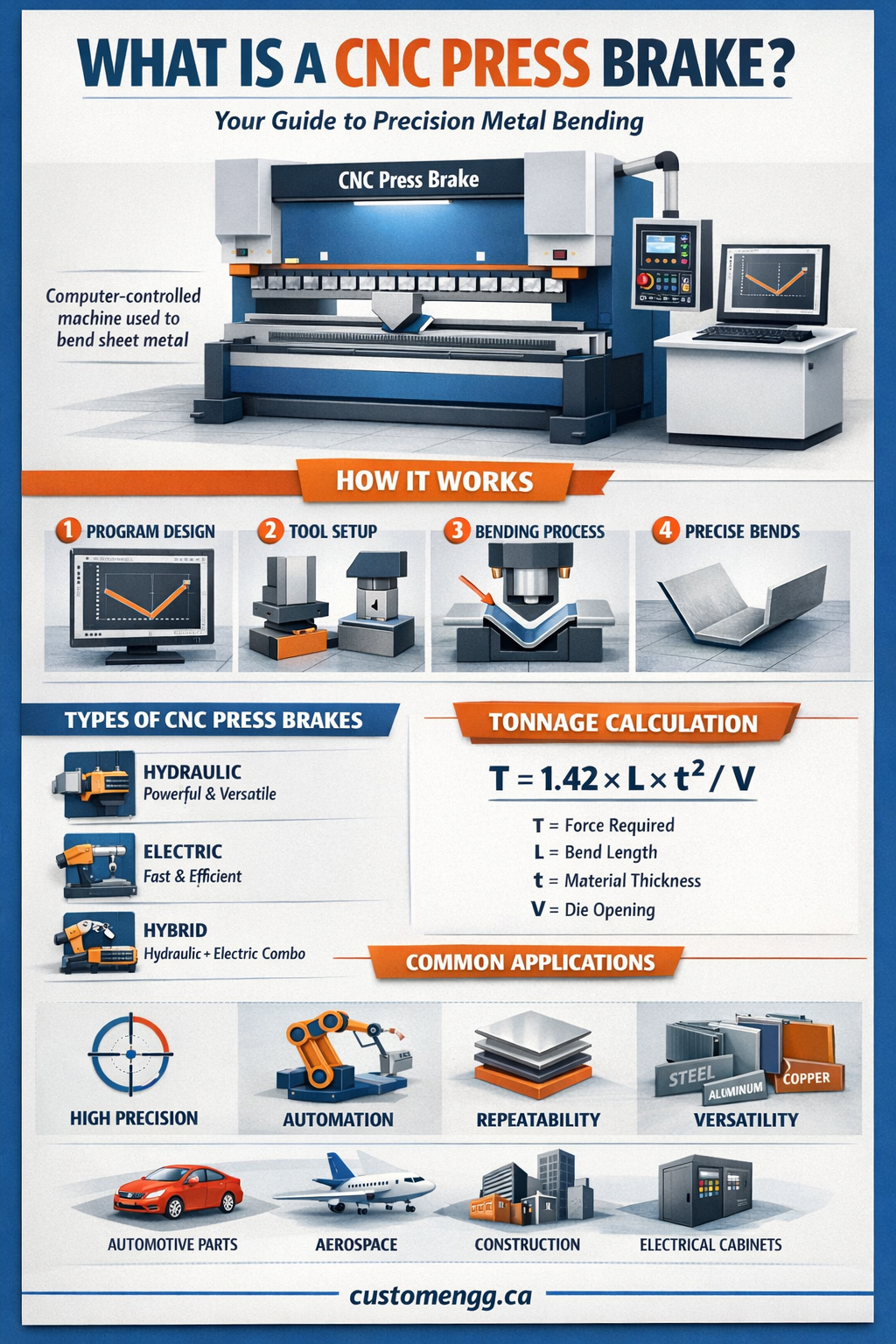
A CNC press brake is a computer-controlled machine used to bend sheet metal into desired shapes by applying force through a punch and die.
Unlike conventional press brakes, CNC machines:
- Use pre-programmed instructions.
- Offer multi-axis control (Y1, Y2, X, R, Z axes).
- Deliver extreme precision and repeatability.
👉 In simple terms:
A CNC press brake transforms flat metal sheets into complex 3D components with high accuracy and minimal human intervention.
Core Working Principle
The CNC press brake operates on the principle of controlled force application:
- A punch (upper tool) moves downward.
- The metal sheet is placed over a die (lower tool).
- The sheet is deformed plastically (permanent bend).
- The CNC system ensures exact angle and depth.
Types of Bending Operations
Understanding bending methods is critical for both design and production:
1. Air Bending
- Most commonly used.
- Punch does not fully press into the die.
- Requires less force.
- Flexible for different angles.
2. Bottoming
- Punch presses the sheet firmly into the die.
- More accurate than air bending.
- Requires higher tonnage.
3. Coining
- High-pressure operation.
- Material is compressed at the bend point.
- Extremely precise but tool-intensive.
CNC Press Brake Axes Explained
Modern CNC press brakes operate on multiple axes:
- Y1 & Y2 Axis – Control ram movement (left/right cylinders).
- X Axis – Back gauge forward/backward.
- R Axis – Vertical movement of back gauge.
- Z Axis – Lateral movement.
👉 More axes = higher flexibility and automation.
Tonnage Calculation (Very Important)
Tonnage determines how much force is required to bend metal.
Here’s the standard formula:
T=1.42×L×t2VT = \frac{1.42 \times L \times t^2}{V}
Where:
- T = Tonnage required.
- L = Bend length.
- t = Material thickness.
- V = Die opening.
Example:
If you are bending:
- Mild steel.
- Thickness = 3 mm.
- Length = 1000 mm.
The tonnage requirement can vary significantly depending on die selection.
👉 This is why CNC programming + tooling selection is critical in real-world fabrication.
Tooling System in CNC Press Brakes
Tooling plays a major role in determining bend quality.
Punch Types:
- Acute angle punch.
- Gooseneck punch (for deep bends).
- Hemming punch.
Die Types:
- V-die (most common).
- U-die.
- Multi-opening die.
Tool Material:
- Hardened steel.
- Carbide (for high precision work).
👉 Proper tooling reduces:
- Springback.
- Tool wear.
- Material damage.
Understanding Springback
One of the biggest challenges in bending is springback.
What is Springback?
After bending, metal tends to slightly return toward its original shape.
Why It Happens:
- Elastic recovery of material.
- Material type (aluminum has more springback than steel).
Solution:
- Over-bending using CNC programming.
- Material-specific calibration.
Key Components of a CNC Press Brake
1. Frame
Heavy-duty structure that holds everything together.
2. Ram
Moves vertically to apply force.
3. Bed
Supports the die and material.
4. Back Gauge
Positions the sheet accurately.
5. CNC Controller
Controls entire operation (angle, speed, depth).
Popular controllers used globally:
- Delem.
- Cybelec.
Types of CNC Press Brakes
1. Hydraulic CNC Press Brake
- Most widely used.
- High tonnage capacity.
- Ideal for thick materials.
2. Electric CNC Press Brake
- Servo motor driven.
- Energy efficient.
- High speed and accuracy.
3. Hybrid Press Brake
- Combines hydraulic + electric.
- Balanced performance.
Materials Used in CNC Bending
CNC press brakes can handle a wide variety of materials:
- Mild Steel.
- Stainless Steel.
- Aluminum.
- Copper.
- Brass.
Each material behaves differently in terms of:
- Ductility.
- Strength.
- Springback.
Advantages of CNC Press Brakes
1. Precision Engineering
Accuracy up to microns level.
2. Automation
Reduces manual labor and errors.
3. Repeatability
Perfect for bulk manufacturing.
4. Complex Geometry
Multi-bend parts can be created easily.
5. Cost Efficiency
Less waste, faster production.
Real-World Applications in Canada
CNC press brakes are essential across industries:
Automotive
- Chassis components.
- Brackets.
Aerospace
- Lightweight precision parts.
Construction
- Structural frames.
- Steel supports.
Energy Sector
- Oil & gas components.
- Renewable energy frames.
Electrical Industry
- Control panels.
- Enclosures.
CNC Press Brake vs Other Machines
| Machine | Function |
|---|---|
| CNC Press Brake | Bending |
| Laser Cutting Machine | Cutting |
| CNC Milling Machine | Shaping |
| CNC Turning Machine | Cylindrical parts |
👉 Press brake = bending specialist.
Common Challenges & Solutions
❌ Incorrect Bend Angle
✔ Solution: Proper CNC calibration.
❌ Tool Wear
✔ Solution: Use hardened tools.
❌ Material Cracking
✔ Solution: Correct bend radius.
❌ Inconsistent Results
✔ Solution: Use automated back gauge.
Why CNC Press Brakes Are Crucial for Canadian Manufacturing
Canada’s manufacturing sector is evolving rapidly with:
- Automation adoption.
- Skilled labor shortages.
- Demand for precision engineering.
CNC press brakes help companies:
- Stay competitive.
- Improve quality standards.
- Reduce operational costs.
Conclusion
A CNC press brake is not just a machine—it’s a core technology driving modern fabrication.
With its ability to deliver:
- High precision.
- Repeatable output.
- Complex geometries.
…it has become indispensable for industries across Canada.
Whether you’re a manufacturer, engineer, or business owner, understanding CNC press brakes allows you to optimize production and achieve superior results.