

What is TIG Welding? A Complete Guide to Precision Welding in Modern Fabrication
Introduction
In industries where precision, durability, and clean finishes are non-negotiable, TIG welding has become a gold standard. From aerospace components to custom metal fabrication, this technique is widely trusted for producing high-quality welds with minimal defects.
At Custom Engineering, TIG welding plays a crucial role in delivering precision-driven fabrication solutions tailored for Canadian industries. But what exactly is TIG welding, and why is it so important?
What is TIG Welding?
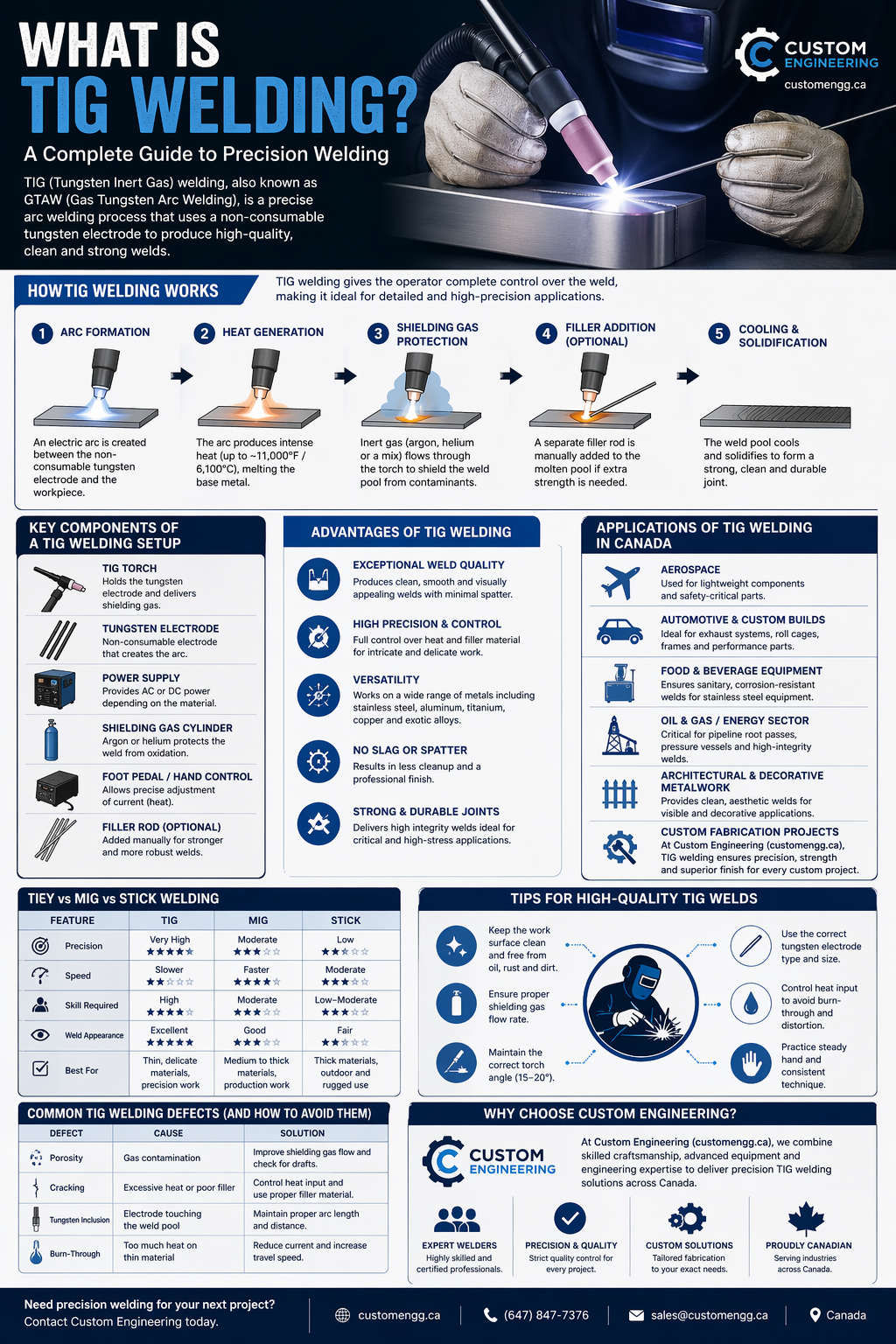
TIG welding stands for Tungsten Inert Gas welding, also known as Gas Tungsten Arc Welding (GTAW).
It is a welding process that uses a non-consumable tungsten electrode to create an electric arc between the electrode and the base metal. This arc generates intense heat, melting the metal to form a weld.
An inert shielding gas—usually argon, helium, or a mixture—protects the weld area from atmospheric contamination such as oxygen and nitrogen.
Unlike other welding processes:
- The electrode does not melt
- Filler material is optional and manually added
- The process offers maximum control and precision
How TIG Welding Works (Step-by-Step)
Understanding the TIG welding process helps highlight why it is considered one of the most refined welding techniques:
1. Arc Formation
An electric arc is created between the tungsten electrode and the workpiece.
2. Heat Generation
The arc produces extremely high temperatures (up to ~11,000°F / 6,100°C), enough to melt most metals.
3. Shielding Gas Protection
Inert gas flows continuously to prevent oxidation and contamination.
4. Manual Filler Addition
If needed, the welder dips a filler rod into the molten pool for added strength.
5. Cooling and Solidification
The molten weld pool cools to form a strong, clean joint.
Components of a TIG Welding Setup
A standard TIG welding system includes:
- TIG Torch: Holds the tungsten electrode
- Tungsten Electrode: Generates the arc
- Power Supply: AC/DC depending on material
- Shielding Gas Cylinder: Argon or helium
- Foot Pedal or Hand Control: Adjusts heat input
- Filler Rod (Optional): Adds material to the weld
Types of Current Used in TIG Welding
DC (Direct Current)
- Used for steel, stainless steel, and copper
- Produces deep penetration and stable arc
AC (Alternating Current)
- Ideal for aluminum and magnesium
- Helps remove oxide layers during welding
Advantages of TIG Welding
1. Superior Weld Quality
Produces clean, smooth, and visually appealing welds with minimal defects.
2. Precision Control
Heat and filler are controlled manually, allowing intricate and delicate work.
3. Versatility Across Metals
Compatible with:
- Stainless steel
- Aluminum
- Titanium
- Nickel alloys
- Copper alloys
4. No Slag or Spatter
Reduces post-weld cleaning time significantly.
5. Strong and Durable Joints
Ideal for high-stress and critical applications.
Limitations of TIG Welding
Despite its benefits, TIG welding has some constraints:
- Slower than MIG or Stick welding
- Requires highly skilled operators
- Higher equipment and labor costs
- Not ideal for thick materials without multiple passes
TIG Welding vs Other Welding Methods
TIG vs MIG Welding
- TIG = Precision, aesthetics
- MIG = Speed, productivity
TIG vs Stick Welding
- TIG = Clean and controlled
- Stick = Rugged, outdoor use
Applications of TIG Welding in Canada
TIG welding is widely used across Canadian industries due to its precision and reliability:
1. Aerospace
Used for lightweight and high-strength components.
2. Automotive & Custom Builds
Perfect for exhaust systems, frames, and performance parts.
3. Food Processing Equipment
Ensures sanitary, corrosion-resistant welds.
4. Oil & Gas Industry
Critical for pipeline root welding and pressure systems.
5. Architectural & Decorative Metalwork
Used where appearance and finish matter.
6. Custom Fabrication Projects
At Custom Engineering (customengg.ca), TIG welding is extensively used for bespoke metal fabrication, ensuring every project meets strict quality and durability standards.
Industries That Benefit Most from TIG Welding
- Manufacturing
- Construction
- Marine
- Energy & Utilities
- Pharmaceutical equipment
- Defense and aerospace
TIG Welding Techniques for Best Results
To achieve optimal weld quality:
- Maintain a short arc length
- Use consistent torch angle (typically 15–20°)
- Keep materials clean and oil-free
- Use proper gas flow rates
- Avoid overheating thin materials
- Practice steady hand coordination
Common TIG Welding Defects (and How to Avoid Them)
| Defect | Cause | Solution |
|---|---|---|
| Porosity | Gas contamination | Improve shielding gas flow |
| Cracking | Excess heat or poor filler | Control heat input |
| Tungsten inclusion | Electrode touching weld pool | Maintain proper distance |
| Burn-through | Too much heat | Reduce current |
Why Choose TIG Welding for Custom Engineering Projects?
For high-precision fabrication needs, TIG welding offers unmatched advantages:
- Clean, professional finish
- High structural integrity
- Suitable for complex geometries
- Minimal rework required
At Custom Engineering (customengg.ca), TIG welding is part of a broader commitment to delivering precision-engineered solutions for clients across Canada. Whether it’s a one-off custom piece or a production batch, TIG welding ensures consistent quality and performance.
Future of TIG Welding in Canada
With increasing demand for:
- Lightweight materials
- High-performance components
- Clean and aesthetic finishes
TIG welding in canada continues to evolve with automation, robotics, and advanced power sources, making it even more efficient and reliable.
Conclusion
TIG welding is one of the most precise and high-quality welding processes available today. While it requires skill and patience, the results are unmatched in terms of strength, appearance, and reliability.
For businesses and industries that cannot compromise on quality, TIG welding remains a top choice. And with experienced providers like Custom Engineering , clients can expect world-class fabrication tailored to their exact requirements.